
Hiring takes time most managers do not have. Roles stay open, résumés pile up, good candidates drift away, and the people doing the interviewing still have their day jobs. Partnering with a staffing agency or recruitment process outsourcing (RPO) provider is one of the most common fixes, but it only works well when you pick the right model and the right partner.
This guide covers when outside recruiting help makes sense, what it really costs, how to choose a partner, how to get the most from the relationship, and how to tell whether it is paying off.
Signs your hiring process needs help
Most companies do not decide to outsource hiring in the abstract. They do it because something is not working. Common warning signs include:
- Roles stay open for months. SHRM’s benchmarking puts the median time-to-fill for nonexecutive roles at 39 calendar days. If you are routinely well beyond that, something in the process is stuck.
- Plenty of applicants, few qualified ones. Volume is not the same as a pipeline. Hiring managers wading through irrelevant résumés is a sign sourcing and screening need work.
- Candidates drop out mid-process. Slow replies, long gaps between interviews and unclear next steps push people toward faster employers.
- Offers get turned down. This often points to pay that is out of step with the market, or a candidate experience that did not build enough trust.
- New hires leave early. Early turnover usually means the role, the person or the expectations were not properly matched.
- Your managers are recruiting instead of managing. When leaders spend hours a week screening and scheduling, the rest of the business pays for it.
If two or three of these sound familiar, the issue is usually not effort. It is capacity, process or reach, and that is exactly what a good recruiting partner adds.
What a staffing agency or RPO partner actually does
Staffing agencies
A staffing agency finds and places people in specific roles. Depending on the arrangement, that can be a permanent hire, a temporary worker or a contractor who may later convert to a permanent employee. The scale is significant: according to the American Staffing Association, nearly 2.2 million temporary and contract employees worked for US staffing companies in an average week in 2024.
Recruitment process outsourcing (RPO)
RPO goes further. Instead of filling one vacancy at a time, an RPO partner provides dedicated recruiters and sourcers who work as an extension of your team. They can take on part of the process, such as sourcing only, or the full workflow from intake through interview coordination. RPO is usually the better fit when hiring problems keep repeating, because it builds a repeatable recruiting operation rather than a one-off fix. See how this works on our recruitment process outsourcing page.
The work they take off your plate
- Role intake: clarifying responsibilities, must-have qualifications, pay range, interview stages and deadlines.
- Sourcing: job postings, database searches, professional networks, referrals and direct outreach to passive candidates.
- Screening: checking experience, motivation, availability and pay expectations before anyone reaches the hiring manager.
- Interview coordination: scheduling, reminders, candidate communication and follow-up.
- Offer support: helping align expectations so offers are accepted.
- Reporting: showing outreach, responses, qualified candidates, interviews and bottlenecks.
The real benefits of partnering with a staffing agency
1. Faster access to qualified candidates
A good agency does not start every search from zero. Recruiters maintain networks and talent pools, so the first shortlist can arrive much sooner than it would from a fresh job posting.
2. Reach beyond active job seekers
Many of the best candidates are employed and not looking. Specialist recruiters spend their time building relationships with exactly those people, and they know how to approach them in a way that earns a reply.
3. Better screening, fewer wasted interviews
When candidates are screened properly for skills, motivation and fit, hiring managers spend their time on a short list of people who can do the job, rather than on first-round calls that go nowhere.
4. Market knowledge
Agencies that work in your industry see many searches, many offers and many rejections. That gives them a realistic view of pay, candidate expectations and what competitors are offering, which helps you set up a role that can actually be filled.
5. Flexibility
Hiring demand rarely stays flat. A partner lets you scale recruiting up during growth or seasonal peaks and back down in quieter periods, without hiring and laying off internal recruiters.
6. A better candidate experience
Prompt replies, clear next steps and honest feedback reflect well on your brand. Recruiters whose job is communication tend to do it more consistently than a busy manager can.
7. Your team gets its time back
The most underrated benefit is simple: your leaders go back to running the business.
What it costs, and how it can save money
Understand your current cost-per-hire first
Before comparing agency fees, know what hiring costs you today. SHRM’s latest benchmarking puts the average cost-per-hire at $5,475 for nonexecutive roles and $35,879 for executive roles. Your own number should include:
- Job board and advertising spend.
- Applicant tracking and sourcing tools.
- Internal recruiter salaries, or the share of HR time spent on hiring.
- Hiring manager time spent screening and interviewing.
- Background checks and assessments.
- The cost of the role staying empty: overtime, delayed projects or lost sales.
Common pricing models
- Contingency or placement fee: common for direct hire. You pay when a candidate is hired, often as a percentage of first-year salary.
- Markup on pay rate: common for temporary and contract staff. The agency employs the worker and bills you an hourly rate that covers wages, payroll taxes and its margin.
- Retained search: used for senior or confidential roles. Part of the fee is paid up front to secure dedicated effort.
- Hourly RPO: you pay for recruiter or sourcer hours. Useful for short backlogs or urgent sourcing projects.
- Monthly RPO retainer: a set monthly fee for dedicated recruiting capacity. Best for ongoing hiring with predictable costs.
- Project RPO: scoped around a defined hiring push, such as a new location or a group of similar roles.
Where the savings come from
Savings rarely come from the fee alone. They come from fewer weeks with a role unfilled, fewer hours of manager time lost to screening, lower job board spend, and fewer early departures because the match was better. When you compare options, compare the total cost of getting a productive person into the seat, not just the invoice.
Staffing agency vs RPO: which do you need?
| Your situation | Likely best fit |
|---|---|
| One or two hard-to-fill roles | Staffing agency (direct hire or contract) |
| Short-term backlog or an urgent sourcing push | Hourly recruiter or sourcer support |
| Hiring continuously across several teams | Monthly RPO retainer |
| Opening a new site or hiring many similar roles at once | Project RPO or volume recruitment |
| Seasonal peaks or cover for absences | Temporary staffing |
| Senior leadership or confidential searches | Executive search |
Choose hourly recruiter or sourcer support when
- You need extra sourcing capacity for a limited period.
- Your internal recruiter has an urgent backlog.
- You want to test an outside partner before a bigger commitment.
Choose a monthly RPO retainer when
- You hire throughout the year or across several departments.
- You want recruiters who learn your company, roles and standards.
- You want a steady pipeline instead of restarting the search for every vacancy.
- You need predictable costs and weekly visibility.
How to choose the right staffing agency
Start with your own needs
Before you talk to any agency, write down:
- The roles you need to fill and whether they are permanent, temporary or contract.
- The must-have skills and experience for each.
- Your realistic pay range and budget for recruiting.
- How quickly you need people in the seat.
- What your culture and working style are really like, including remote or on-site expectations.
That one page will make every agency conversation sharper and help you compare answers fairly.
Questions to ask every agency
- Which industries and roles do you recruit for most often?
- How do you find candidates beyond job boards?
- What does your screening include before we see a candidate?
- Who will be our day-to-day contact, and how often will we get updates?
- How are fees calculated, and what happens if a hire does not work out?
- Can you support more than one hiring model if our needs change?
- Can we speak to current clients in a similar industry?
Red flags
- A flood of résumés with little evidence of screening.
- Vague answers on fees, replacement terms or who owns the relationship.
- No questions about your culture, team or why the role is open.
- Promises of guaranteed hires in unrealistic timeframes.
Finding talent in niche markets
Specialist roles, whether that is a licensed clinician, a structural engineer or an underwriter, need a more targeted approach. A few principles make a big difference:
- Define the profile tightly, then trim the wish list. Be exact about the few skills that truly matter and drop the rest. Every unnecessary requirement shrinks an already small pool.
- Work with recruiters who know the field. They know where these candidates gather, which credentials matter and how to talk about the work credibly.
- Expect to go after passive candidates. In niche markets, most qualified people are employed. Direct, personal outreach is usually the only way to reach them.
- Be realistic about pay and flexibility. Scarce skills command a premium. So does flexibility, where the role allows it.
BreezyRecruit recruits across sectors including healthcare, professional services, financial services, construction and IT. You can see the full list on our industries page.
Recruiting for remote and hybrid roles
Remote and hybrid work are now a normal part of the US labor market. BLS data shows that in March 2026, 22.6 percent of workers teleworked or worked at home for pay. For employers, that widens the talent pool but adds new challenges.
- Be clear about the arrangement. State in-office days, time-zone expectations and any travel in the job description.
- Assess remote working skills. Use structured behavioral questions about how candidates have handled written communication, independent work and collaboration across distance.
- Run video interviews well. Test the technology in advance, keep the same structure for every candidate, and give people a chance to ask about the team.
- Mind state rules. Hiring in a new state can bring different payroll, tax and employment law requirements. An experienced partner can help you plan for these.
- Plan onboarding before day one. Equipment, system access, a named buddy and regular early check-ins make remote hires productive faster.
Small businesses: getting big-company recruiting without the overhead
Small businesses feel hiring pain more sharply. There is often no dedicated HR team, the owner is doing the interviewing, and one bad hire can affect the whole company. Outsourcing gives a small business access to recruiting expertise and reach without adding full-time headcount.
For small teams, flexible models make the most sense. Hourly recruiter support or a scoped hiring project lets you pay for what you need, when you need it. RPO is not only for large companies. Small and mid-sized businesses use it too, often starting small and scaling up as hiring grows.
How to get the most from the partnership
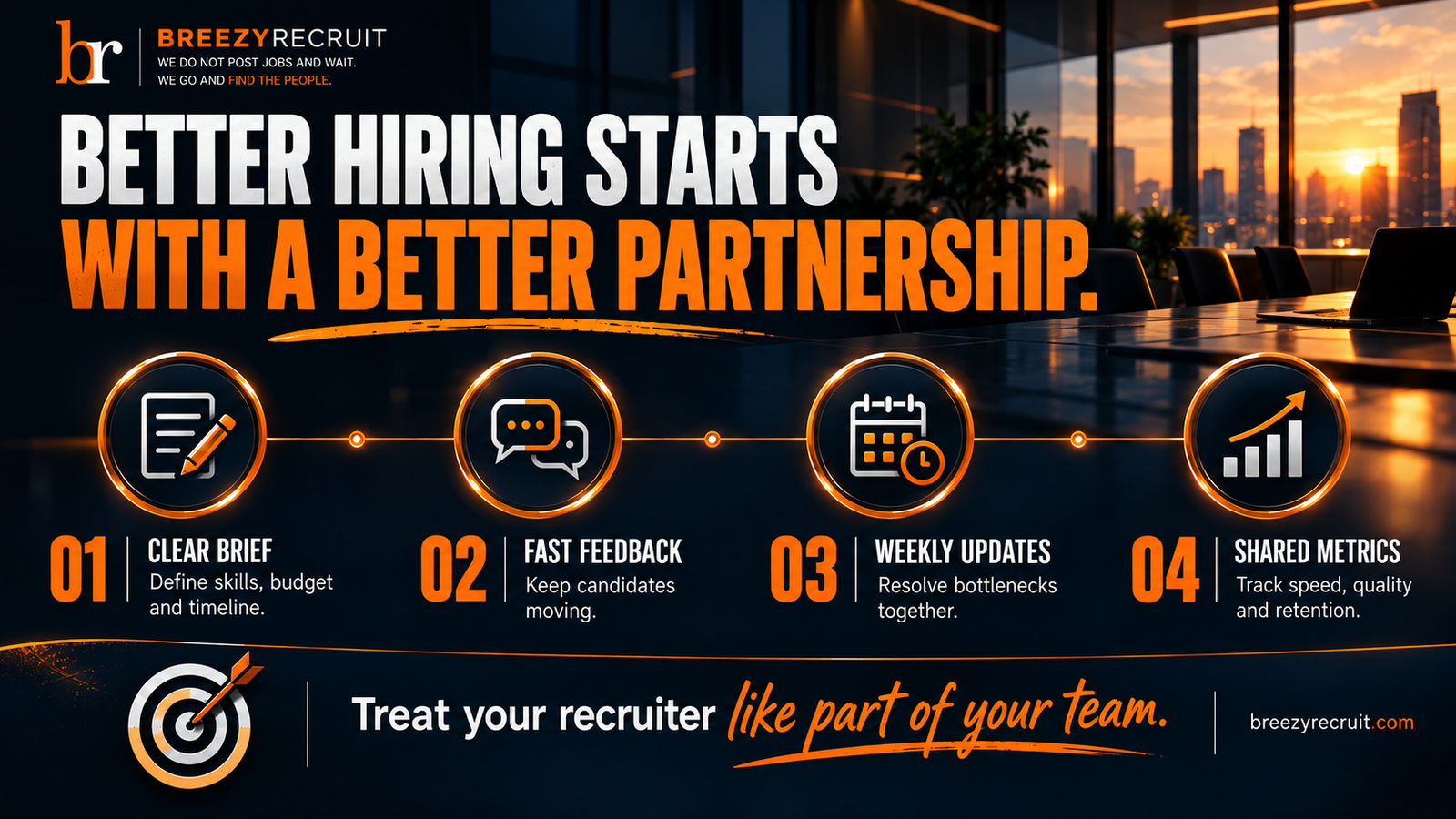
- Invest in the intake call. The more your partner understands the role, the team and why past hires succeeded or failed, the better the shortlist.
- Give fast feedback. Tell your recruiter within a day or two why a candidate is or is not a fit. That feedback sharpens the next round.
- Agree on KPIs. Time-to-fill, candidates submitted per hire, interview-to-offer ratio, offer acceptance and early retention are a good starting set.
- Set a regular check-in. A short weekly update keeps everyone aligned and surfaces problems early.
- Treat them like part of the team. Share context about upcoming hiring so they can build a pipeline before roles open.
Measuring the ROI of staffing solutions
You do not need a complicated formula. Compare a few numbers before and after you bring in a partner:
- Time-to-fill: how many days from approval to accepted offer?
- Cost-per-hire: total recruiting spend divided by hires, including internal time.
- Quality of hire: hiring manager ratings and performance at 90 days and one year.
- Early turnover: the share of new hires who leave within their first year.
- Cost of vacancy: overtime, missed revenue or delayed projects while roles were open.
Review these quarterly. If a partner is working, you should see faster fills, steadier quality and fewer surprises. If not, the numbers give you a clear basis for a conversation.
Frequently asked questions
Why should a company use a staffing agency?
A staffing agency gives you faster access to screened candidates, reach into passive talent you may not find on your own, market knowledge on pay and expectations, and the flexibility to scale hiring up or down. It also frees your managers to focus on running the business.
How much does a staffing agency cost?
It depends on the model. Direct hire is usually a one-time placement fee, temporary and contract staff are billed at an hourly rate that includes a markup, and RPO can be priced hourly, monthly or by project. Ask for a clear breakdown before you sign.
What is the difference between a staffing agency and RPO?
A staffing agency typically fills individual roles. RPO provides dedicated recruiters and sourcers who run all or part of your recruiting process as an extension of your team, which suits ongoing or repeated hiring.
Is RPO only for large companies?
No. Small and mid-sized businesses use RPO to get recruiting expertise and capacity without building a large internal team. Hourly or project-based options make it easy to start small.
How do I choose the right staffing agency?
Look for experience in your industry and roles, a clear sourcing and screening process, transparent fees and replacement terms, a named point of contact and regular reporting. Ask to speak with current clients.
Can a staffing agency help with remote hiring?
Yes. A good agency can source across a wider area, screen for remote working skills, run structured video interviews and help you think through the practical side of hiring in other states.
Let’s fix your hiring together
If roles are staying open too long or your team is stretched thin by recruiting, we can help you choose the right level of support, from a few hours of sourcing to a dedicated recruiting team. Become a BreezyRecruit client and tell us what you are hiring for.
Hiring for a role like this?
BreezyRecruit runs RPO, direct hire, contract and executive search for US employers — and works one-to-one with candidates through Reverse Recruitment.