
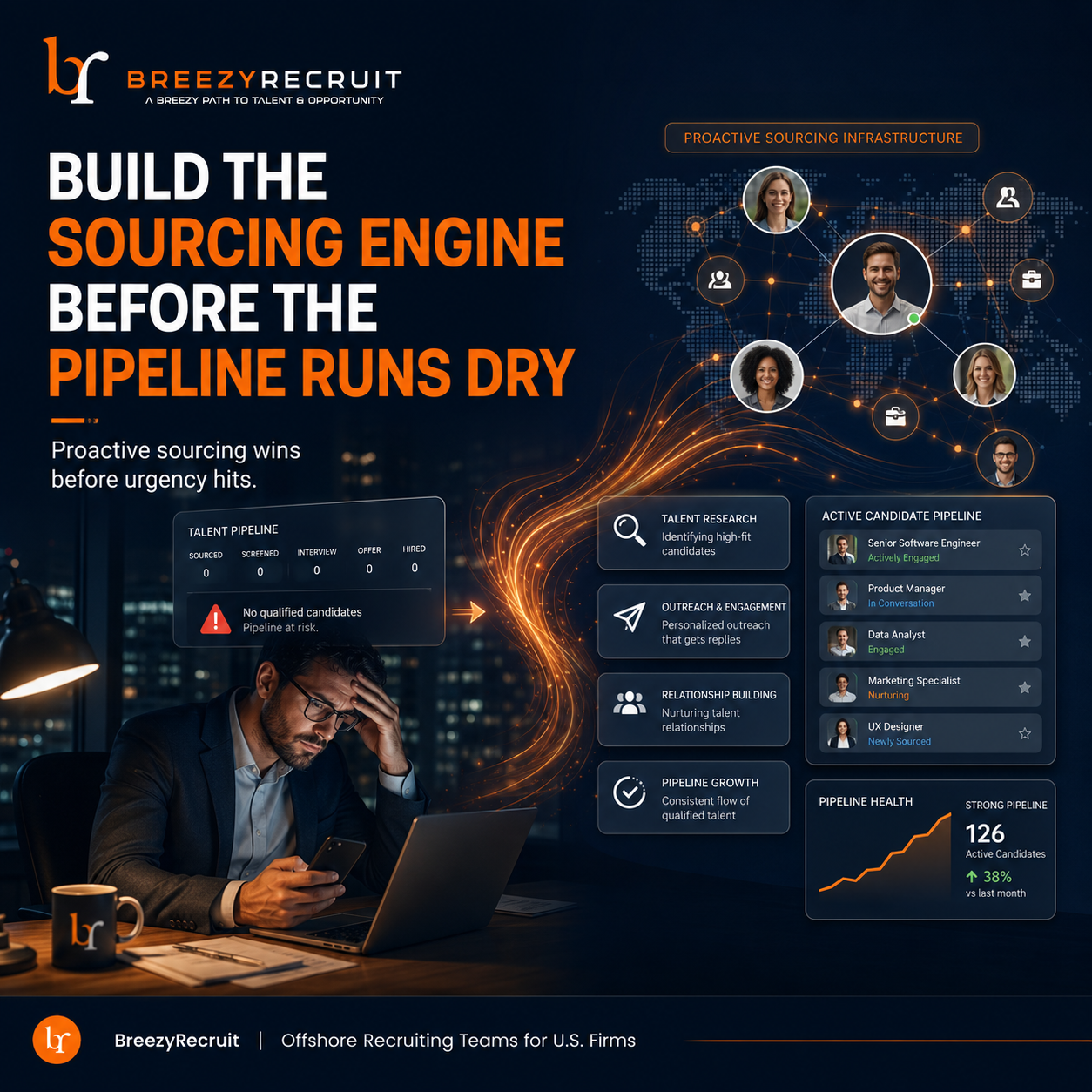
A strong sourcing engine helps staffing firms avoid empty recruiting pipelines when urgent hiring demand arrives. Instead of waiting until a client needs candidates immediately, smart recruiting teams build talent relationships, track qualified candidates, and keep their pipeline active before pressure hits.
The hiring pipeline never collapses when it is convenient.
It usually happens late at night, when your biggest client is asking why interviews are not on the calendar, your recruiters are refreshing the ATS, and the candidates who looked promising last week have already accepted another offer.
Most staffing firms do not lose momentum because they lack clients.
They lose momentum because they cannot consistently deliver qualified candidates when demand increases.
That is why a sourcing engine is no longer optional for staffing firms, recruiting agencies, and growing companies. It is the difference between reacting to hiring demand and being ready before the demand arrives.
A healthy sourcing engine allows your team to build relationships, map talent pools, engage passive candidates, and maintain a warm pipeline long before a job order becomes urgent.
If your team only starts sourcing when a role opens, you are already behind.
Why Recruiting Pipelines Break at the Worst Time
A recruiting pipeline often looks healthy from the outside.
The ATS has resumes. The job posting has applicants. The spreadsheet has names. The team has activity.
But activity is not the same as pipeline strength.
A real pipeline is not measured by how many resumes sit in your system. It is measured by how many qualified, interested, reachable candidates you can move into conversation quickly.
This is where many staffing firms get stuck.
They wait until a client sends an urgent role. Then the sourcing team starts from zero. Recruiters search LinkedIn, review job board applicants, send outreach messages, and hope candidates respond fast enough.
By that point, top candidates may already be speaking with another employer.
The issue is not always the recruiter’s effort. Many recruiters are working hard. The issue is that the system is reactive.
Reactive recruiting creates pressure at every stage.
Hiring managers expect shortlists quickly.
Recruiters rush outreach.
Candidates receive generic messages.
Follow-ups become inconsistent.
Qualified talent falls through the cracks.
Clients lose confidence.
When this pattern repeats, the problem is not one bad search. It is a weak sourcing infrastructure.
What a Sourcing Engine Actually Means
A sourcing engine is a repeatable system for finding, engaging, organizing, and nurturing candidates before hiring demand becomes urgent.
It is not just a LinkedIn Recruiter seat.
It is not just an ATS.
It is not just a sourcer sending messages every day.
A sourcing engine includes the people, process, tools, and data that make candidate generation consistent.
A strong sourcing engine usually includes clear intake information, defined candidate personas, target company lists, Boolean search strings, talent mapping, LinkedIn sourcing, database sourcing, personalized outreach, follow-up sequences, candidate relationship management, pipeline tracking, reporting, and feedback loops.
The goal is simple.
When the client says, “We need candidates,” your team is not starting from scratch.
You already know where the talent is.
You already know which candidates have been contacted.
You already know who replied three months ago but was not ready.
You already know which profiles match the role.
That is what separates a sourcing engine from random sourcing activity.
Why Job Boards Are Not Enough
Job boards still have value, but they cannot be the foundation of a serious recruiting strategy.
The best candidates are often not applying.
They are already employed. They are performing well. They are not spending every morning searching job postings.
This is especially true for senior, technical, healthcare, sales, finance, and leadership roles.
If your recruiting strategy depends mainly on active applicants, you are competing for the same candidate pool as every other agency.
That creates three problems.
First, candidate quality becomes inconsistent.
Second, your response time slows down because your team has to filter through too many irrelevant applications.
Third, you lose access to passive candidates who would consider the right opportunity if approached properly.
This is why proactive sourcing matters.
You need a team that can identify talent before they enter the market, start meaningful conversations, and build trust over time.
The Role of Offshore Recruiting Teams in Building a Sourcing Engine
For many U.S. staffing firms, the biggest challenge is not understanding the need for sourcing.
They already understand it.
The challenge is capacity.
Internal recruiters are often busy managing clients, screening candidates, coordinating interviews, handling feedback, and trying to close offers.
They do not always have enough time to do deep market research, build target lists, send personalized outreach, and follow up consistently.
This is where offshore recruiting teams can become a real advantage.
A dedicated offshore sourcing team can support your internal recruiters by handling the heavy front-end work.
This includes researching target companies, building candidate lists, finding contact information, sending first-touch outreach, managing follow-ups, updating the ATS or CRM, keeping pipelines warm, and preparing qualified candidate profiles.
This allows your internal recruiters to focus on higher-value work, such as candidate conversations, client communication, interview preparation, and offer management.
The result is not just lower cost.
The result is more consistency.
When offshore recruiting is managed properly, it gives staffing firms the ability to scale their sourcing function without immediately adding expensive internal headcount.
What Most Firms Get Wrong About Sourcing
Most firms treat sourcing like a task.
The better firms treat sourcing like infrastructure.
That difference matters.
A task is something you do when there is an open role.
Infrastructure is something that runs continuously, even when there is no urgent requirement.
When sourcing is treated as a task, the team is always behind.
When sourcing is treated as infrastructure, the team builds momentum before the pressure arrives.
This is the non-obvious part of recruiting operations.
The best time to source for a role is before the role exists.
That does not mean you know every future job order in advance.
It means you understand your core markets well enough to build reusable talent pools.
For example, a staffing firm that regularly hires sales professionals should always have a warm sales pipeline.
A healthcare staffing firm should always be nurturing nurses, allied health professionals, and healthcare support talent.
An IT staffing firm should always be mapping developers, engineers, cloud professionals, cybersecurity talent, and project managers.
This is how firms reduce panic hiring.
They stop treating every search like a brand-new problem.
How to Build a Sourcing Engine That Works
Building a sourcing engine does not require making everything complicated.
It requires discipline.
Start with your most common roles.
Identify the positions your clients request most often. These are the roles where your sourcing engine will create the fastest return.
Build candidate personas.
Define the skills, titles, industries, locations, compensation expectations, and career motivations of your ideal candidates.
Create target company lists.
Know where strong candidates are likely to be working today. This makes sourcing more focused and less random.
Set outreach standards.
Generic messages do not work well with passive candidates. Your outreach should be clear, relevant, and written like a human being.
Use follow-up sequences.
Many placements come from the second, third, or fourth touchpoint. A sourcing engine needs consistent follow-up, not one message and silence.
Track everything.
Every candidate conversation should be recorded. Who replied? Who is interested later? Who changed jobs? Who referred someone? This information becomes more valuable over time.
Review pipeline health weekly.
Measure reply rates, qualified candidates added, candidates screened, interviews booked, and pipeline gaps. What gets measured improves.
Why This Matters for Staffing Firm Owners
Staffing firm owners do not just need more candidates.
They need predictable candidate flow.
That is what clients are really paying for.
A client does not care how many profiles your team reviewed.
They care whether you can deliver qualified, interested candidates before the role becomes a business problem.
When your sourcing engine is strong, you can respond faster.
You can protect client relationships.
You can reduce recruiter burnout.
You can improve placement rates.
You can take on more roles without breaking delivery.
You can scale without depending on one or two overworked recruiters.
This is where recruiting becomes an operational advantage.
How BreezyRecruit Helps Build Sourcing Capacity
BreezyRecruit helps staffing firms, recruiting agencies, and growing businesses build dedicated offshore recruiting support.
Our teams assist with sourcing, candidate research, outreach, screening support, ATS management, talent pool building, and recruitment process support.
The goal is not to replace your internal recruiters.
The goal is to give them the capacity and structure they need to perform better.
When your internal recruiters are supported by a strong offshore sourcing team, they can spend more time with clients and candidates, while the pipeline keeps moving in the background.
That is how recruiting becomes scalable.
Final Thoughts
The firms that win are not always the firms with the biggest tools or the largest teams.
They are the firms that build recruiting systems before they urgently need them.
A sourcing engine gives your business the ability to move faster, serve clients better, and reduce the chaos that comes with last-minute hiring demand.
If your team is constantly scrambling to find candidates after a role opens, the problem is not effort.
The problem is infrastructure.
And the best time to fix that is before your next urgent client request arrives.
If your staffing firm needs consistent candidate sourcing support, BreezyRecruit can help you build a dedicated offshore recruiting team that keeps your pipeline moving before demand turns into pressure.
Visit our RPO Services page to learn how BreezyRecruit can support your hiring operations.
FAQ
What is a sourcing engine in recruitment?
A sourcing engine is a structured system for continuously identifying, engaging, tracking, and nurturing candidates before roles become urgent. It includes research, outreach, follow-up, CRM or ATS tracking, and pipeline reporting.
Why do staffing firms need a sourcing engine?
Staffing firms need a sourcing engine because client demand can change quickly. A proactive sourcing system helps firms respond faster, reduce recruiter pressure, and improve candidate delivery.
How does offshore recruiting help with sourcing?
Offshore recruiting teams can support sourcing, research, outreach, candidate list building, ATS updates, and follow-ups. This gives internal recruiters more time to manage clients, screen candidates, and close placements.
Is sourcing only useful for active roles?
No. The strongest sourcing happens before roles become urgent. Building warm talent pools in advance helps recruiters move faster when a client opens a new requirement.
What is the difference between sourcing and recruiting?
Sourcing focuses on finding and engaging potential candidates. Recruiting includes the full process of screening, interviewing, managing client feedback, offer coordination, and candidate closing.
Hiring for a role like this?
BreezyRecruit runs RPO, direct hire, contract and executive search for US employers — and works one-to-one with candidates through Reverse Recruitment.
Keep reading
More hiring notes
 5 Mar 2025How AI and Data-Driven Talent Sourcing Can Improve Your Hiring ProcessDid you know bad hires can cost companies big money? Some studies say it can be…Read article →
 24 Feb 2025How to Use Automation and AI to Improve Volume Hiring in 2025Are you ready for a change? The year 2025 will change how companies find lots of…Read article →
